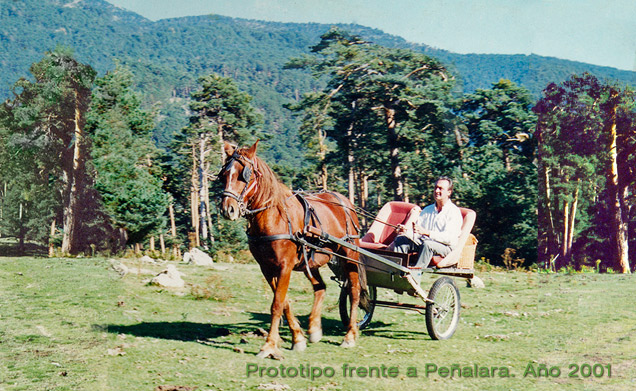
The designer
For more than fifty years, Javier Navarro has devoted his life to observing how machines work, how materials respond, and where the problems others consider inevitable actually come from.
A racer, builder, mechanic, designer and inventor out of necessity more than profession, he has developed a very personal way of creating: always starting from real experience to arrive at solutions that are simple, efficient and durable.
He has never understood design as a theoretical exercise. His way of working is to build, test, correct and start again until he finds a better solution. That philosophy is present both in the Navarro lightweight horse carriage and in the rest of the projects he has developed throughout his career.
During the 1970s he found in motocross an exceptional laboratory for understanding how vehicles behave. In those days riders didn't just race: they also stripped engines, modified suspensions, made their own parts, fixed breakdowns mid-race and learned to read the behaviour of a machine under the most demanding conditions.
Every improvement meant understanding the relationship between weight, strength, geometry, suspension, grip and load distribution a little better. Those years ended up becoming a genuine school of applied engineering.
He didn't just learn to ride. He learned why a part breaks, how a structure can be made lighter without losing strength, what effect every modification has on a vehicle's behaviour, and how a good technical solution always starts from understanding the problem rather than adding complexity.
That way of learning the hard way has a very concrete example. On an off-road motorcycle crossing from Madrid to the Pyrenees without touching asphalt — following the course of the Henares river with nothing but a compass and a road map —, he decided to carry the fuel in a roughly twelve-litre can placed right in front of the handlebars.
"I never would have imagined how negative the effect of those kilos in that spot would be, especially when the can was half full and the fuel sloshed around," he recalls. "It was exhausting for the arms […] a real ordeal to get up a loose-stone track uphill."
Those twelve badly placed litres weren't just extra weight: it was weight in the wrong place, shifting the centre of gravity to exactly where every bump was felt the most. Decades later, that same lesson — that it's not enough to cut weight if it isn't positioned correctly — is what places the centre of gravity of the Navarro lightweight horse carriage directly above the axle, so the carriage has a neutral behaviour at the shafts in any circumstance.
His progress as a rider allowed him to break into national competition circles during one of the most important eras of Spanish motorcycling. He raced alongside some of the riders who defined that generation and kept a close relationship with Montesa's competition department, where he got a first-hand look at the technical evolution of factory motorcycles.
He represented Spain at the Motocross des Nations Juniors — the Motocross de l'Avenir — in Belgium, one of the most prestigious international events for young riders, sharing the track with future World Championship figures.
Over those years he crossed paths with and worked alongside names that are now part of motorcycling history, such as Ángel Nieto, Eduardo Giró Mendívil, Salvador Cañellas, Antonio Zanini, Guillermo Moreno de Carlos, Jean-Claude Jobé, Pedro Pi and Pedro Permanyer, among others. He also collaborated with Motociclismo magazine, carrying out technical tests of new Montesa models, an experience that further strengthened his ability to analyse a vehicle's behaviour from a technical standpoint, not just as a rider.
A serious injury ended that sporting chapter early, but the learning stayed with him for good. Over the years he has come to recognise that, beyond the sporting results, what truly mattered was discovering a way of understanding mechanics and design that still accompanies him today.
Ideas never stayed on paper. Every modification had to survive thousands of kilometres of trails, trips, competitions and real-world tests. There were rebuilt engines, redesigned suspensions, purpose-made components, unsupported mountain crossings, expeditions where reliability depended solely on decisions made during the design phase, and a multitude of solutions developed to overcome problems that seemed inevitable.
That way of working ended up defining a method of his own, based on a few very simple principles: strip out everything unnecessary; cut weight without losing strength; simplify mechanisms; make maintenance easier; improve dynamic behaviour; always design with real-world use in mind. These are principles still present in all his projects.
Throughout his career, Javier Navarro has developed solutions for very different fields: from vehicles to fire-suppression systems, filtration devices, energy solutions and mechanisms designed to improve the operation of traditional equipment.
Although the projects differ, they all respond to the same way of thinking. "I've never designed to make something different," he sums up. "I've always designed to solve a problem that had been accepted as inevitable for too long."
That's why every new project starts by observing how things actually work, spotting their limitations, and rethinking the solution from the ground up.
At first glance, a racing motorcycle and a horse carriage might seem to belong to completely different worlds. Yet both obey exactly the same laws of physics: stability, weight distribution, suspension, centre of gravity, impact absorption, structural strength and weight shape the behaviour of any vehicle equally.
Decades of working with those principles made it possible to approach the design of the Navarro lightweight horse carriage from a perspective completely different from the traditional one. Rather than reproducing solutions handed down for generations, the project began with a much simpler question: what would the best possible horse carriage look like today, if we could design it from scratch, with today's knowledge and materials?
The answer was a radically different vehicle: lighter, more stable, stronger, more efficient, more comfortable for the horse and safer for whoever drives it.
Those who know Javier Navarro agree on one common trait: he never stops asking how to improve things. A conversation, a trip, a breakdown or an everyday observation can become the starting point for a new idea.
He doesn't see design as an aesthetic exercise or a display of cleverness. He sees it as a continuous process of observation, experimentation and improvement. "Every project starts the same way," he explains. "With a simple question: what if it could be done better?"
From there begins a process of observation, design, construction and testing that doesn't end until the solution proves its worth in real conditions. That way of working has stayed with Javier Navarro his whole life and is the common thread running through all his projects, regardless of the sector they belong to.
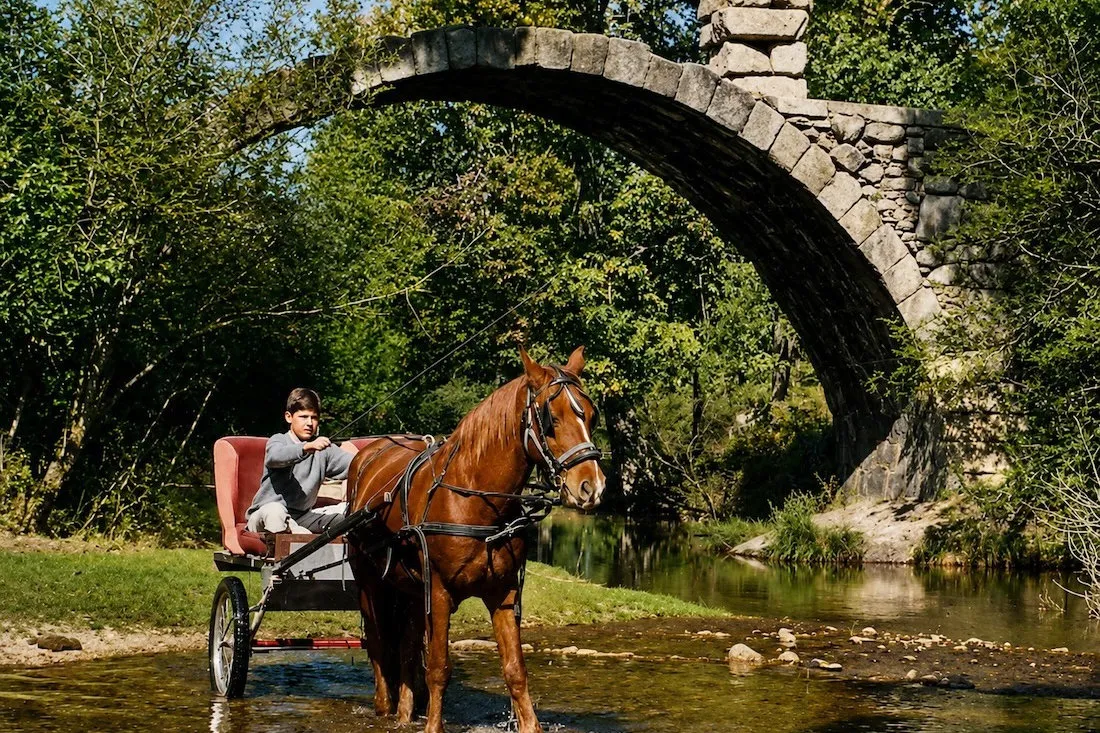
This photograph shows one of the earliest versions of the carriage, still without the aluminium side rails or the footrest that the Navarro lightweight horse carriage has today. It isn't, then, a product shot: it's a record of how every prototype was tested from day one, in real conditions and not on a showroom floor.
The one driving it in this image is a child. That's not an incidental detail: if a design is neutral and predictable enough for someone with no strength or experience to handle it confidently, that says something concrete about its behaviour, long before any engineering data existed to prove it.
There's a detail that appears in no spec sheet and no business plan. While recounting that off-road motorcycle crossing from Madrid to the Pyrenees — the one with the badly placed fuel can, the cold nights without a sleeping bag and the kilometres with no asphalt — Javier Navarro wrote, years before the Navarro lightweight horse carriage was a real product:
"Maybe one day I'll do something similar again, but instead of on a motorcycle, I'll do it in my horse carriage."
It wasn't a slogan dreamed up for a website. It was an intention written for himself, at a time when the horse carriage didn't yet exist as we know it today. The rest of this page — the chassis, the Kevlar, the centre of gravity — is the story of how that intention eventually became a real vehicle.
Want to discover the carriage born from this way of understanding design? See the carriage. If you already know you want one, request your quote.